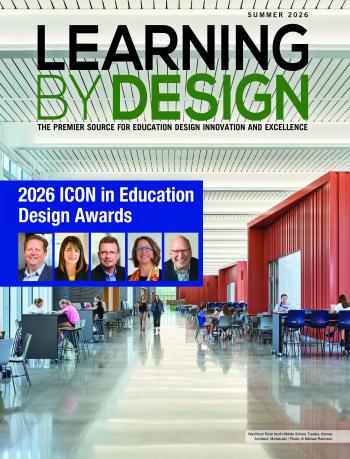
CLEVELAND, OH (June 5, 2026) - Learning By Design magazine, the premier source for education design innovation and excellence, proudly announces the release of its Summer 2026 edition. At a time when schools and universities are navigating rapid change driven by evolving pedagogy, technology, student wellness priorities, sustainability goals, and community needs, the Summer 2026 edition challenges readers to view educational facilities as adaptable environments that support continuous growth and innovation.
In his opening editorial, “Design for Change, Build for Growth,” Publisher Mark Goodman emphasizes that flexibility and resilience must become foundational design principles. He encourages architects, educators, planners, and industry partners to create environments capable of evolving alongside future educational needs while fostering equity, inclusion, and student success.
A centerpiece of the issue is the 2026 ICON in Education Design Awards, which honors individuals whose leadership, creativity, and dedication have significantly advanced the educational built environment. Representing multiple disciplines, this year’s recipients demonstrate how visionary thinking can positively influence learning outcomes, strengthen communities, and inspire future generations.
The issue also features thought leadership from Learning By Design’s partner organizations, including The Association for Learning Environments (A4LE), the American Institute of Architects Committee on Architecture for Education (AIA CAE), the Association of University Interior Designers (AUID), and the Coalition for the Advanced Understanding of School Environments (CAUSE).
In his Letter from the CEO, John K. Ramsey, CAE, highlights the growing momentum across the learning environments profession and underscores the value of collaboration among educators, architects, planners, manufacturers, and facility leaders. He notes that stronger interdisciplinary partnerships and professional development opportunities are essential to addressing the increasingly complex challenges facing educational institutions.
The American Institute of Architects Committee on Architecture for Education (AIA CAE) contributes an analysis of recent Educational Facility Award winners, identifying several key trends shaping exemplary learning environments. These include sustainability as a visible teaching tool, adaptive reuse of existing buildings, high-performance design strategies, and biophilic approaches that support health, wellness, and student engagement. Together, these projects demonstrate how thoughtful design can advance both educational and environmental goals.
The Association of University Interior Designers (AUID) examines the critical role of Furniture, Fixtures, and Equipment (FF&E) in educational environments. The article argues that furniture should be viewed not as a finishing touch, but as a strategic component that directly influences learning, belonging, collaboration, and long-term facility performance.
Research remains a major focus throughout the issue. In the latest installment of CAUSE’s ongoing series, “What Gets Measured Gets Better,” researchers explore the impact of acoustics on student achievement, teacher well-being, and educational equity. The findings highlight how classroom noise and reverberation can significantly affect learning outcomes and reinforce the importance of measuring environmental performance in schools.
Additional articles address several of the most pressing and evolving issues influencing educational facility planning and design today. Topics include rethinking privacy, dignity, and inclusivity within school locker room environments; exploring how modern school bond programs are increasingly being leveraged to fund technology integration, safety enhancements, sustainability initiatives, and student wellness investments beyond traditional “bricks and mortar” construction; and examining the growing body of research supporting child-centered seating solutions in early learning environments. Together, these articles highlight how educational facilities are being challenged to respond to changing social expectations, support diverse learner needs, and create environments that promote physical comfort, emotional well-being, engagement, and academic success.
Two feature articles provide deeper insight into the relationship between research, design, and educational success. In “When District Vision Meets Research-Driven Design: A District–Designer Partnership Approach for Student Success,” Crystal Ball O’Connor, PhD, and Will Anderson examine the assessed performance of educational facilities one year after occupancy, demonstrating how post-occupancy evaluation and data-driven assessment can validate design decisions, strengthen accountability, and inform future investments in learning environments.
The issue also features “When Great Design Isn’t Enough: Why Learning Space Integration Is the Missing Link in School Design” by Kevin Stoller, founder of Kay-Twelve and a national advocate for active learning environments. Stoller explores how architecture alone cannot maximize educational outcomes unless pedagogy, instructional practices, and the physical environment are intentionally aligned. The article challenges educators and designers to think beyond the building itself and focus on how learning spaces are actively integrated into teaching and learning experiences.
Collectively, the Summer 2026 edition reinforces a powerful message: educational facilities achieve their greatest impact when they are designed around people rather than programs. Through evidence-based research, innovative planning, sustainability, and visionary leadership, the projects and professionals featured in this issue demonstrate how thoughtful design can create lasting benefits for students, educators, and communities.
About Learning By Design
Learning By Design is the premier source for education design innovation and excellence. Published three times annually, the magazine serves architects, interior designers, educational facility planners, school district leaders, higher education professionals, manufacturers, and industry partners committed to creating high-performing learning environments. Learning By Design is the official publication of The Association for Learning Environments (A4LE) and is produced in partnership with leading organizations serving the educational facilities community.
For more information, read the Summer (June 2026) edition.